
Introduction
Vehicle repair costs in the United States have risen sharply over the past several years. The average unplanned repair bill and major failures like engine replacement or transmission rebuild routinely run into thousands. The core reason is postponed vehicle maintenance Dallas that allowed minor, inexpensive problems to develop into major ones. A missed oil change and an ignored brake squeal are the starting points of failure sequences. They cost far more to repair than the routine service that would have interrupted them.
This guide shows you precisely how routine vehicle maintenance saves money and improves safety. We will address every specific service category, including oil, tires, brakes, and more. We will also provide you with clear guidance on intervals, warning signs, and the Dallas auto repair shop costs that skipping each service invites. Planned servicing always costs a fraction of emergency auto repair Dallas, and the gap widens with every year of neglect.
The Real Cost of Skipping Maintenance
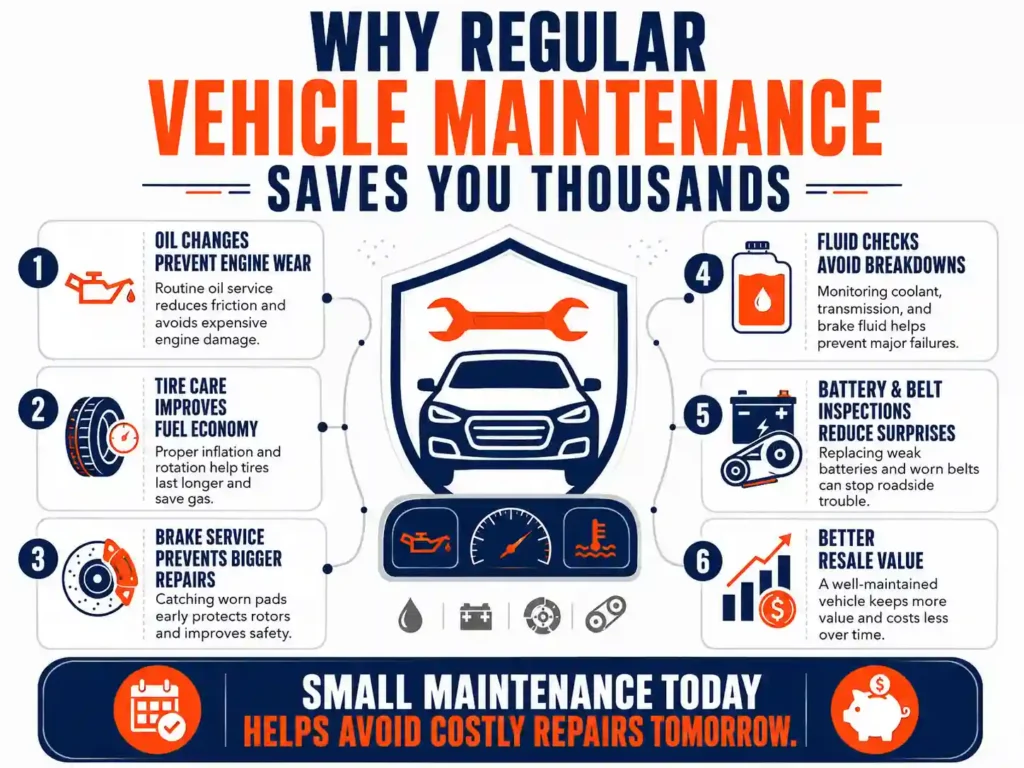
Emergency Repairs vs. Planned Servicing
Emergency Repair
An emergency car repair Dallas happens when a component fails without warning. It leaves the driver stranded. The local shops don’t find any opportunity to order parts in advance or schedule work efficiently. The bill gets inflated surprisingly because of emergency labor rates and expedited parts sourcing. The compounded damage caused by driving on a failing component also contributes to the final cost.
Planned Servicing
Planned servicing allows the technician to inspect the components and replace them before they fail. They catch a worn brake pad before it scores the rotor. They change the timing belt before it snaps and bends valves. The car maintenance Dallas cost of the service is predictable, schedulable, and almost always a fraction of the repair bill that follows a preventable failure.
Long-Term Damage
Engine
An engine running on degraded oil develops bearing wear, sludge accumulation, and camshaft damage. These damages progress through stages of increasing severity. They cost high if the degradation sequence runs its course unchecked.
Transmission
The transmission is the second most expensive component in the drivetrain. It is also among the most sensitive to fluid neglect because if it gets degraded, the fluid loses its lubricating and cooling properties. It results in clutch pack wear, solenoid damage, and eventual gear slippage.
Resale Value
A vehicle service Dallas with a documented maintenance history commands a measurably higher resale and trade-in value. It is because buyers and dealers use maintenance history as a proxy for the mechanical condition. It helps them because they cannot directly inspect at the point of sale.
How Often Should I Change My Oil?
Conventional oil requires changing every five thousand miles under normal driving conditions. Full synthetic oil is engineered to last around ten thousand miles. It depends on the manufacturer’s specification and the severity of the operating environment.
Clean oil maintains the hydrodynamic film; it neutralizes combustion acids through its additive package. It also suspends contaminants in solution until they are removed at the next service. When oil loses its protection, bearings wear faster, sludge builds up, and the engine suffers damage, all preventable with timely oil changes.
When Should I Replace My Tires?
You should replace them when tread depth falls to 2/32 of an inch. It is the legal minimum in most states. Age is also an independent replacement trigger regardless of tread depth. Rubber degrades from UV exposure and oxidation over time.
Most manufacturers recommend replacement at six years regardless of apparent condition. They also suggest a tire change every ten years as an absolute maximum. Worn tires extend stopping distances measurably. They also reduce lateral grip in cornering and significantly increase the risk of aquaplaning on wet roads.
Beyond safety, underinflated and worn tires increase rolling resistance. They also raise fuel consumption and accelerate the uneven wear patterns. It directly contributes to shortening the tire’s remaining service life.
How Often Should I Get My Brakes Checked?
Brake pads on most passenger vehicles last around seventy thousand miles. Their life also depends on driving style, vehicle weight, and the pad compound. City driving and frequent heavy braking increase wear significantly faster than highway use.
Most brake systems include a wear indicator like a small metal tab. It contacts the rotor when pad thickness drops to the replacement threshold. It produces the characteristic high-pitched squealing that signals imminent replacement.
Ignoring that squeal allows the pad backing plate to contact the rotor directly. It can produce grinding that scores the rotor surface and converts a low-cost brake pad job into a high-priced rotor replacement.
What Fluids Should I Check Regularly?
A vehicle service Dallas depends on five distinct fluid systems, including engine oil, coolant, brake fluid, transmission fluid, and power steering fluid. Each of them performs a specific function that no other fluid can substitute for and degrades in a specific way when neglected.
- Engine oil lubricates and cools internal engine components
- Coolant regulates operating temperature and prevents freeze damage
- Brake fluid transmits hydraulic pressure through the braking system
- Transmission fluid lubricates and cools the gearbox
- Power steering fluid maintains hydraulic assist for steering effort.
Neglecting any one of these fluid systems allows the component to generate excess heat, increase internal wear, or lose the functional capacity it was built to provide. A simple monthly check of all five fluid levels and conditions, taking under five minutes, is the most cost-effective vehicle maintenance Dallas habit available.
How Long Do Car Batteries Last?
The average car battery has a service life of three to five years under normal operating conditions, with heat accelerating internal degradation. Battery failure is rarely dramatic; rather, the most common pattern is a gradual reduction in cranking power. It then goes unnoticed until a cold morning or a day of heavy electrical load produces a no-start event at an inconvenient time and location.
Modern battery testers can measure a battery’s actual remaining capacity as a percentage of its rated output. They allow replacement to be scheduled before failure rather than after. This is an important advantage because a failed battery often strands the driver far from home.
Why Is My Car Overheating?
Engine overheating is commonly caused by a low coolant level. It sometimes occurs because of a blocked or leaking radiator or a failing water pump. All of these factors prevent the cooling system from removing combustion heat from the engine at the rate it is generated.
An engine that reaches and sustains temperatures above its design operating range begins suffering thermal damage in a sequence that escalates rapidly. The first warning is almost always the temperature gauge rising into the red zone or an overheated warning light.
Both of these should prompt an immediate safe stop. When you keep driving an overheating engine, it can cross the threshold. It results in a catastrophic engine failure. Maintaining the correct coolant level and inspecting regularly prevent overheating.
Ready to Save Thousands Through Regular Maintenance of Your Vehicle?
The most expensive vehicle repairs in Dallas are almost always preventable. They are the end result of maintenance that was overlooked, one service interval too many. They arrive as emergency bills that planned servicing would have replaced with predictable, manageable costs. Pro Quick Lube & Auto Repair provides comprehensive vehicle maintenance Dallas, performed by experienced technicians using the right tools for your specific vehicle. Visit proautomotiveservice.com to schedule your next service appointment. Keep your vehicle in a condition that maintains safety and protects its resale value for the long term.
Frequently Asked Questions
Why is car maintenance important?
It prevents issues from developing by addressing them in their early stages. It keeps every vehicle system operating within its designed parameters. It protects all the components from wear and tear.
How can I save money on car repairs?
The most effective way to reduce car repair Dallas costs is to follow the manufacturer’s maintenance schedule. Catching developing problems during routine inspections allows them to be addressed before they damage adjacent components.
What does a car service include?
A standard car service typically includes an oil and filter change along with fluid level checks and top-ups. Tire pressure inspection and rotation, brake inspection, belt and hose visual check, and a battery test also come under the service scope.
Where is the best auto repair in Dallas?
Pro Quick Lube & Auto Repair is a trusted auto repair Dallas shop. It offers comprehensive maintenance and repair services performed by experienced technicians using professional diagnostic equipment.
When should I maintain my car?
Maintenance should be performed on the schedule defined by your vehicle’s manufacturer rather than waiting for warning signs. A professional inspection every six months and before any long trip provides an additional safety net.