
Introduction
Auto shops routinely bundle car wheel alignment and tire balancing during new tire installations. This common sales practice tricks drivers into thinking they are identical services. While both issues hide in the wheel well and destroy your tires, they stem from completely distinct mechanical faults. A single severe pothole can easily knock a clip-on weight off your rim and bend a suspension rod simultaneously. The dual symptoms appear overnight.
Separating these two services keeps money in your bank account. Loose suspension angles cause immediate lane drift and increase emergency stopping distances by altering your footprint on the road. Recognizing the distinct mechanical signs between wheel alignment vs tire balancing allows you to decline unnecessary shop recommendations. You will know exactly what your car requires before stepping up to the service counter.
What is Wheel Alignment?
Definition and Purpose
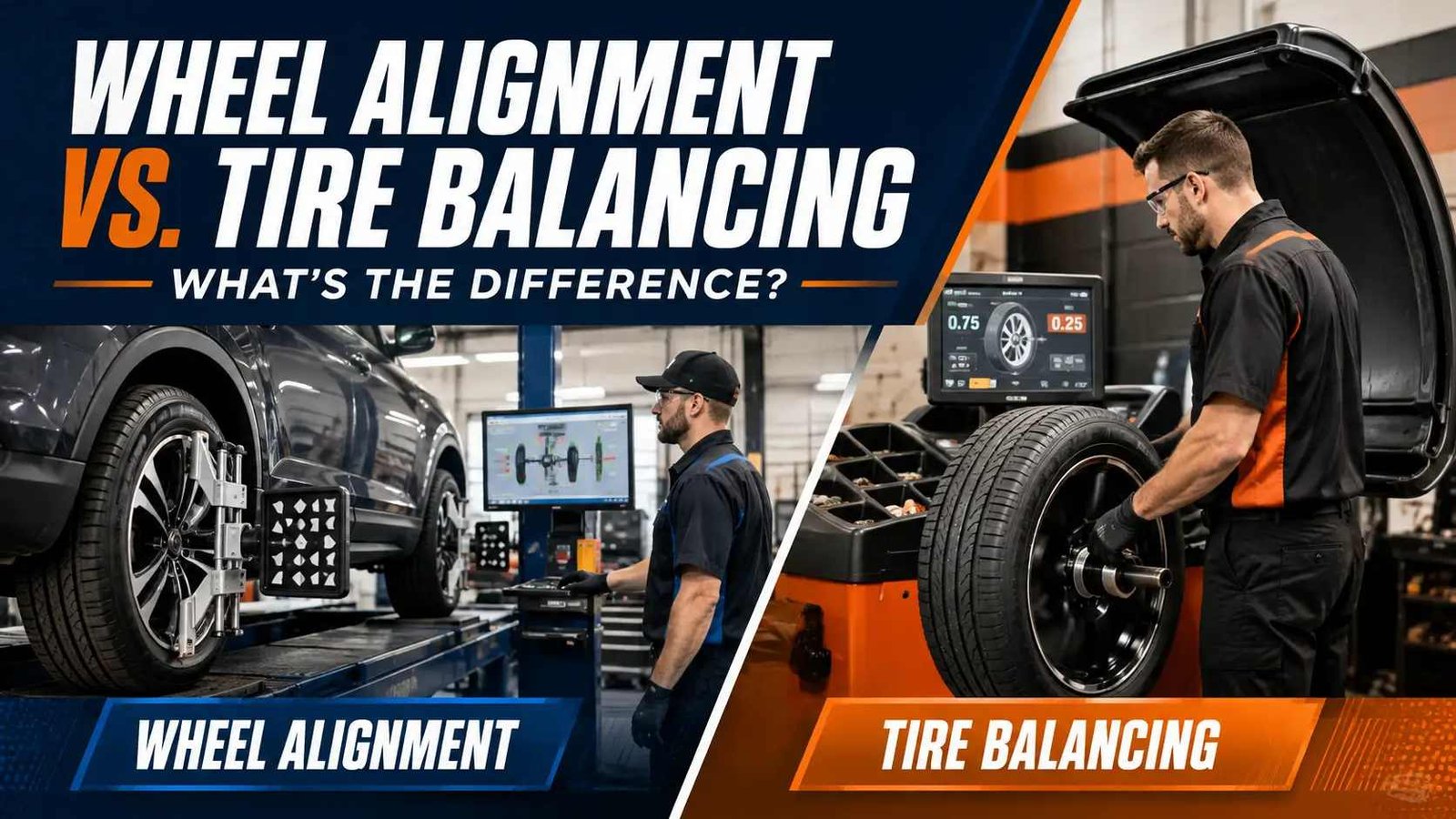
Alignment deals strictly with the vehicle’s suspension network. This system of rods, bars, and control arms anchors the car to its wheels. The process forces these components back into factory-specified angles. Wheels must point perfectly straight ahead while remaining entirely vertical to the asphalt. Technicians measure these tracking positions down to tiny fractions of a degree. This calibration directly targets specific mechanical angles called camber, caster, and toe.
Effects on Vehicle Performance
Proper steering geometry ensures effortless handling. The car tracks straight without constant physical driver correction. When these angles slip out of spec, tires drag sideways down the highway. Think of a crooked shopping cart wheel. This continuous sideways dragging generates massive rolling resistance. Your engine burns extra fuel just to maintain highway speed. A bad angle quickly shaves down the inner or outer edges of your tires, destroying fresh rubber within weeks.
Signs Your Car Needs Alignment
The car pulls hard toward the ditch the second you ease your grip on the steering wheel. Your steering wheel logo stays crooked or tilted while the vehicle moves in a perfectly straight line. Tires might also chirp or squeal during slow garage turns. Run your hand across the tire tread blocks. If you feel sharp, saw-toothed edges pointing in one direction, your alignment is actively grinding down the rubber.
What is Tire Balancing?
Definition and Purpose
Tire balancing corrects weight flaws inside the wheel assembly itself. Manufacturing raw rubber and pouring alloy rims creates natural density variations. One spot on the tire always weighs slightly more than the rest. Mechanics mount the wheel onto a high-speed spin balancer to isolate these heavy zones. They attach small metal counterweights to the inner or outer rim lip to equalize the spinning mass. This layout neutralizes centrifugal forces at highway speeds.
Effects on Ride Comfort and Vibration
Balanced wheels guarantee a quiet cabin experience. Unbalanced assemblies mimic an off-center washing machine drum during a heavy spin cycle. The heavy spot on the tire slams into the pavement hundreds of times per minute. This repeating kinetic energy travels directly up your vehicle’s structural pillars. It shakes the floorboards and wears out wheel bearings, struts, and rubber suspension bushings ahead of schedule.
Signs Your Car Needs Balancing
Imbalanced wheels cause speed-specific shaking that starts around 55 mph. A vibrating steering wheel indicates a front-axle problem. Shaking felt in your seat or floorboards points to a rear-axle weight issue. Visually check your rims. You might see empty spots where old clip-on weights fell off, or clean squares left by missing sticky weights. The tread will develop a wavy, scalloped wear pattern over time.
Difference Between Wheel Alignment vs Tire Balancing
| Feature | Wheel Alignment | Tire Balancing |
| Mechanical Focus | Vehicle suspension angles and steering linkage | Weight distribution of the tire and rim assembly |
| Core Problem | Wheels point in different directions or tilt | One specific side of the wheel is heavier |
| Primary Symptom | Car pulls to the side; crooked steering wheel | Vehicle or steering wheel shakes at highway speeds |
| Correction Method | Adjusting suspension bolts and tie rods | Attaching metal weights to the rim edge |
Do I Need Wheel Alignment or Tire Balancing?
Situations Requiring Wheel Alignment
Book an alignment after any hard curb strike or pothole impact that jars your steering. You must also perform this calibration after changing structural parts like struts, tie rods, or control arms. Watch for a crooked steering wheel or flat bald strips on the tire edges. Regular checks are smart every 12,000 miles if your daily route includes gravel roads or construction zones.
Situations Requiring Tire Balancing
Balancing is required whenever you install brand-new tires. Mechanics must also rebalance the assemblies during routine tire rotations every 6,000 miles to offset uneven wear. If a weight flies off during a car wash, you will need a rebalance immediately. Request a check if you patch a puncture or notice thick mud dried inside the wheel barrels.
Wheel Alignment vs Tire Balancing Costs
How Much is a Wheel Alignment?
| Service Type | Cost Range | Best Suited For |
| Four-Wheel | $100 – $200 | Modern cars, sports sedans, and crossovers with independent rear suspensions. |
| Two-Wheel | $50 – $100 | Front-end adjustments; built for older vehicles with solid rear axles. |
| Lifetime Package | $200 – $250 | High-mileage drivers want free checks and adjustments every 6,000 miles. |
How Much Does Tire Balancing Cost?
| Service Type | Cost Per Tire | Best Suited For |
| Standard | $15 – $30 | Regular maintenance to fix highway vibrations ($60–$120 for a full set). |
| Road-Force | $40 – $60 | Performance sports cars, luxury sedans, or heavy trucks with oversized wheels. |
| New Tire Bundle | $15 (flat rate) | Bundled maintenance when purchasing an entirely new set from major tire retailers. |
Factors Affecting Tire Balancing vs Alignment Pricing
Vehicle Type and Complexity
European imports and heavy trucks cost more to service due to complex multi-link designs. Modern cars with lane-keep assist or radar systems need extra digital calibration. Technicians must reset the steering angle sensor so safety computers match the physical wheel direction, adding to the baseline labor charge.
The Type of Service Provider
Independent local mechanics offer the most competitive rates. Dealerships charge a heavy price premium for the same physical adjustments. However, dealers utilize factory software and model-specific shims. Large tire warehouses often include free balancing with a purchase but bill separately for alignments.
Custom Wheel Modifications
Oversized rims and off-road tires require extra shop labor. Custom wheels require adhesive tape-on weights hidden inside the spokes instead of standard clip-on weights. Low-profile tires take longer to mount safely without scratching expensive painted aluminum finishes.
Discovered Suspension Damage
Machines cannot align a vehicle with loose or worn parts. If a pre-alignment inspection reveals bad ball joints or loose tie rods, those parts must be replaced first. Buying new components significantly increases your initial repair bill.
Stacking or Bundling Services
Combining alignment, balancing, and tire rotations saves money. The vehicle is already on the lift with wheels off, cutting down the technician’s setup time. Check shop websites for digital bundle coupons to lower the retail cost.
Final Analysis
Wheel balancing fixes the car’s suspension tracking angles, while tire alignment fixes weight flaws in the wheel itself. Regular care keeps your ride smooth, maximizes tire life, preserves fuel economy, and protects expensive steering components from premature wear. Missing the warning signs turns simple shop maintenance into premature tire replacement bills. That’s why it’s important to seek professional help in a timely manner, preferably on a fixed schedule at least every six months. For this purpose, you can contact Pro Quick Lube & Auto Repair. They are a leading auto repair company specialized for only European luxury cars. Along with providing services, they also guide you on the core difference between wheel alignment vs tire balancing services and their impacts on your driving.